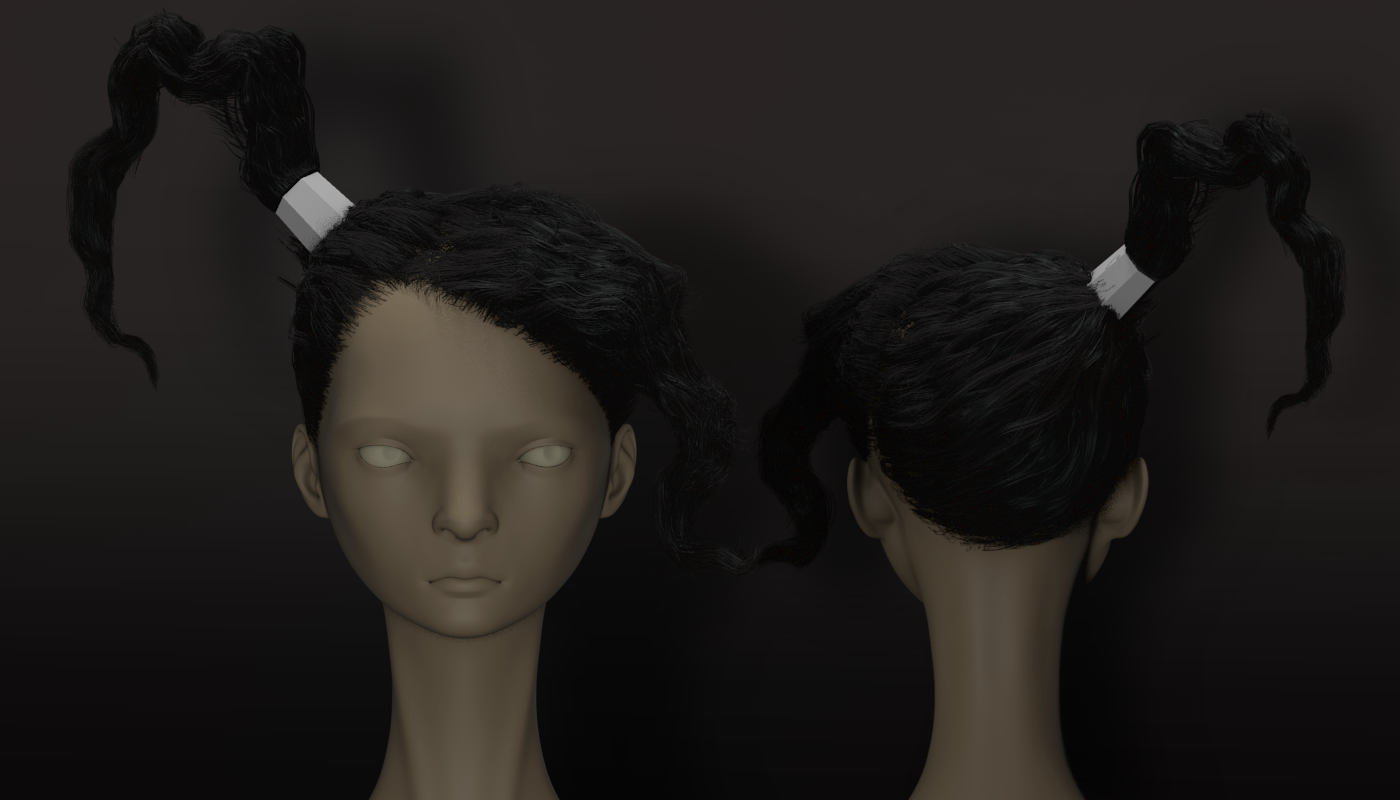
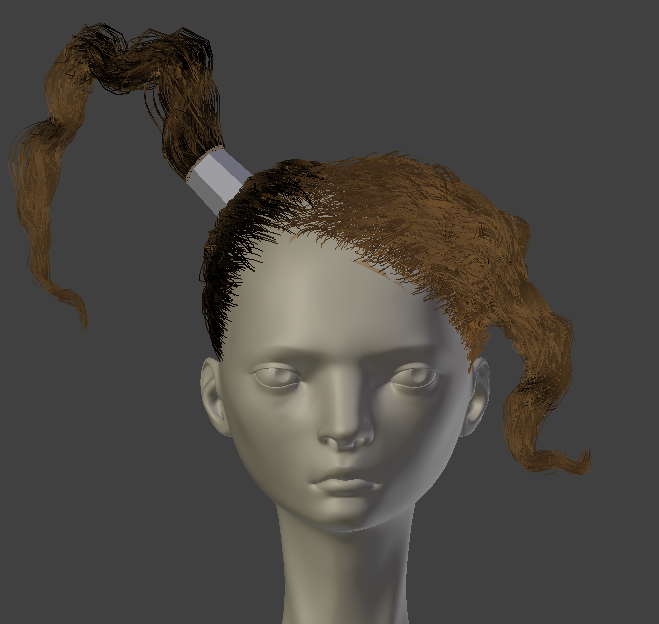
After a long battle with Blender, I came up with this hair using 9 particle systems (so far!) and using Curve-Guides to create the shape of the hair from the concept art: For animation we can rig the curves using joints to create overlap with the hair, and perhaps we might be able to use […]
Here hair, here
After a long battle with Blender, I came up with this hair using 9 particle systems (so far!) and using Curve-Guides to create the shape of the hair from the concept art:
For animation we can rig the curves using joints to create overlap with the hair, and perhaps we might be able to use sim also. Here’s an OpenGL preview:
Raymond Curver – a script for rubberhose animation
Adding rubberhose style control to a section of arm/leg is either not dynamic (just crank up the ease values on the bbones) or laborious (as in mancandy’s rig, with at least a lattice, curve, a bunch of extra bones and constraints, some modifiers, etc.) I hadn’t planned on rubberhosing Gilgamesh, but one of the animators […]
Raymond Curver – a script for rubberhose animation
Adding rubberhose style control to a section of arm/leg is either not dynamic (just crank up the ease values on the bbones) or laborious (as in mancandy’s rig, with at least a lattice, curve, a bunch of extra bones and constraints, some modifiers, etc.)
I hadn’t planned on rubberhosing Gilgamesh, but one of the animators recently expressed that bending limbs ever so slightly can be used to enhance poses even on fairly realistic characters, so he would like the control. I whipped up a quick script/operator to do it, called Raymond Curver so now all I have to do is to select a bunch of verts, then select a bone I want to rubberhose, then run the operator. A quick demo below:
The script is going to be released soon, but it does depend on quite a bit of tube conventions and a bit of knowledge of our pipeline and scripts. This should improve after the project is over and I have time to generalize our tools.
Hi folks, this is a 30 minute explanation of the main rig features, intended for new and continuing animators on the project. It has pretty bad audio (recorded on my phone, with lots of noise and uhms and aahs) and also has been shrunk and compressed quite mercilessly. That being said, it just explains the […]
Gilga rig video for animators
Hi folks, this is a 30 minute explanation of the main rig features, intended for new and continuing animators on the project. It has pretty bad audio (recorded on my phone, with lots of noise and uhms and aahs) and also has been shrunk and compressed quite mercilessly. That being said, it just explains the various features of the rig to be handy for our animators.
I didn’t see any reason not to make this public, so I’m putting it on the main blog:
You can download here: mp4, ogg, or webm in case the in-browser thing doesn’t work.
Today on our way into the Drome from a nice Sunday run+swim, we encountered some unlikely arrivals: a cluster of bright yellow mushrooms growing in the potted plant outside the studio. For your enjoyment: Pics taken with my mobile phone. What do you think, should we eat them? 😉 . Now I wonder if we […]
New life in the Drome
Today on our way into the Drome from a nice Sunday run+swim, we encountered some unlikely arrivals: a cluster of bright yellow mushrooms growing in the potted plant outside the studio. For your enjoyment:
Pics taken with my mobile phone. What do you think, should we eat them? 😉 . Now I wonder if we should use the mushroomer for mushrooms as well as the other things we want to grow/animate with it. If mushrooms can grow in the studio environment, they can live anywhere, including subway stations.
Since Dimetrii just posted his eye material and texture, I thought I’d show this quickie test of the eye rig – missing such things as eyebrows, eyelashes and that insane little membrane on the inside corner by the tear duct. The rig features two directional controls, a track-target and an on-face widget, that can be […]
Eye have something to say
Since Dimetrii just posted his eye material and texture, I thought I’d show this quickie test of the eye rig – missing such things as eyebrows, eyelashes and that insane little membrane on the inside corner by the tear duct.
The rig features two directional controls, a track-target and an on-face widget, that can be used separately or together, a pupil dilator, controllable eyelids that mimic muscle motion but also have a limited vertical track with the eyeball, and an even more limited horizontal one, and a deformational lattice that allows the non-spherical eye to ‘push’ the skin around it. I may add a shrinkwrap to the inner eyelid to make sure it stays on the surface.
Finally, I’d like to thank everybody who, in an idle moment, took a video camera to their eye and posted it on youtube. Viva la crowd-sourced reference!